Every monsoon, the same story plays out across Mumbai, Chennai, Surat, and cities all over India: heavy rain floods drains and burrows, and rats move indoors looking for dry, warm ground. Pest-control companies report their busiest months are July through September, with a second rise across North India between November and February. This isn’t a minor seasonal nuisance — Indian rodents are estimated to destroy several million tonnes of stored grain every year, and monsoon leptospirosis outbreaks linked to rat urine send thousands of people to hospitals in cities like Mumbai and Chennai each season. Add gnawed electrical wiring (a real fire risk), damaged stock in warehouses, and the now-common sight of a rat-chewed car engine bay, and it’s easy to see why so many households and businesses want a rat-control option that doesn’t involve poison around children, pets, or food.
That’s usually where ultrasonic rat repellent devices come into the conversation. This guide covers how they actually work, what independent research says about their effectiveness, and — more importantly — how to set one up so it actually earns its keep.
How Ultrasonic Rat Repellents Actually Work
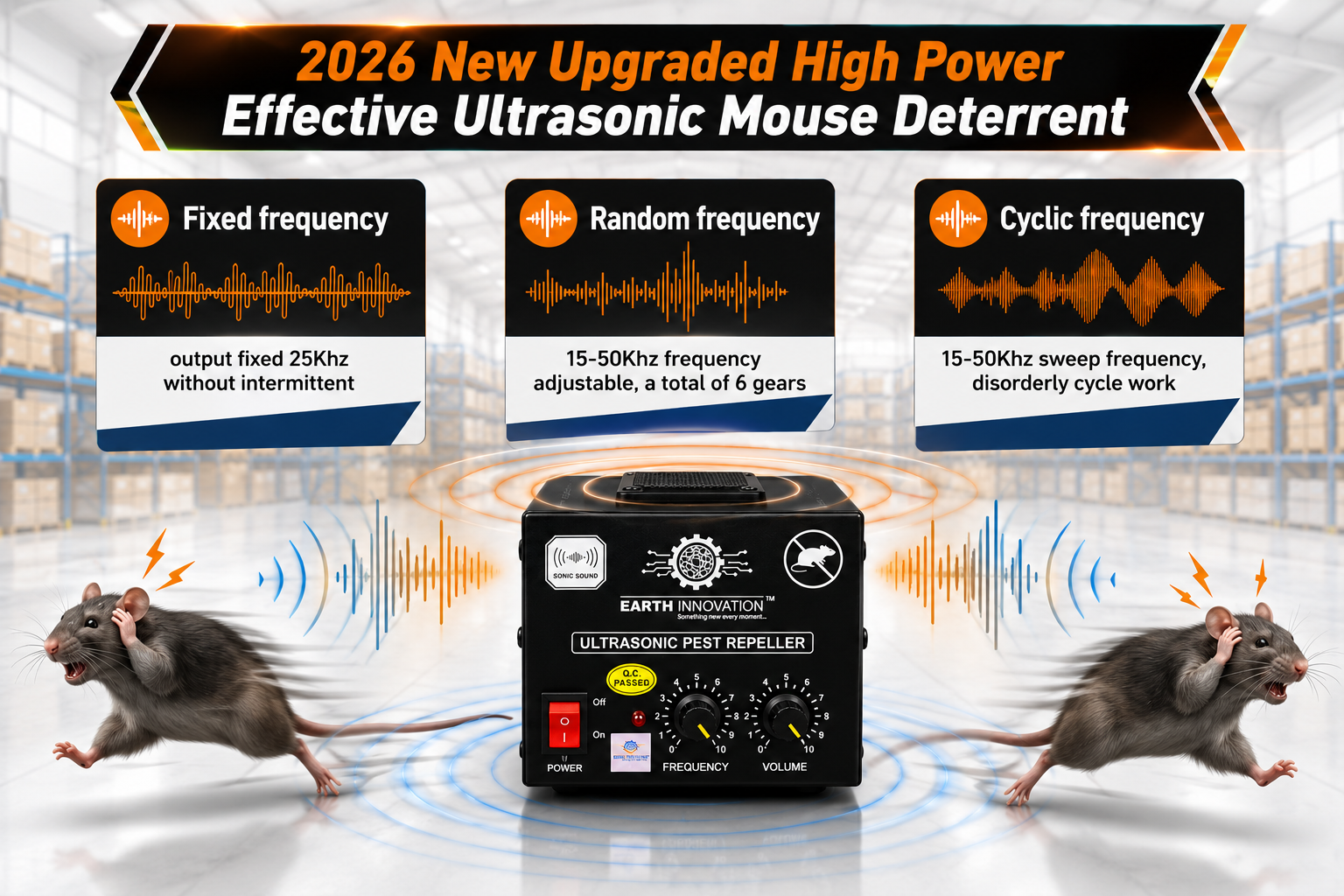
An ultrasonic rat repellent is a small electronic device, usually plug-and-play, that emits high-frequency sound waves designed to make an area uncomfortable for rodents. Most of that output sits above 20 kHz, which is beyond normal human hearing, though wider-range devices — Earth Innovation’s units span 20 Hz to 65 kHz, for instance — do dip into audible frequencies, so you may notice a faint sound standing close to the unit.
The detail that actually matters for effectiveness is how the frequency behaves over time. Basic devices emit one fixed tone, and rodents — like most animals — gradually get used to a sound that never changes. Better-designed units continuously vary both the frequency and the sweep speed, cycling dozens of times a second, specifically so rats can’t fully adapt to it. If you’re comparing devices, this is the single spec worth checking.
Do They Actually Work? An Honest Answer
This deserves a straight answer rather than a marketing one: results genuinely vary, and you should be skeptical of any product claiming guaranteed or total elimination. Regulatory bodies (the US FTC has sent warning letters to dozens of manufacturers over the years) have pushed back on overstated efficacy claims, and independent lab testing has found ultrasonic deterrence inconsistent across different conditions.
At the same time, plenty of households and businesses do report noticeably less rodent activity after installing one — the honest middle ground is that an ultrasonic repeller works best as one layer of rodent control, not a standalone cure. Think of it the way pest-management professionals do: exclusion (sealing entry points) plus sanitation plus deterrence, together, rather than any single method carrying the whole job.
The One Thing That Matters More Than Any Device
If there’s one fact worth remembering from this entire guide, it’s this: killing or repelling the rats currently inside your home or Godown is temporary unless you also close off how they’re getting in. A mouse can squeeze through a gap about the width of a coin’s edge, and a rat through a gap not much bigger — which means most homes and commercial buildings already have several entry points large enough without anyone noticing.
Before or alongside installing any repellent device:
- Seal gaps around AC pipes, gas lines, and drain openings with steel wool and cement filler (rodents can chew through plain foam or plastic filler)
- Fit fine mesh over bathroom and kitchen drains and exhaust vents
- Add door sweeps to close gaps under external doors
- Store food — including pet food and grain — in sealed containers, and keep waste covered
None of this replaces an ultrasonic device; it’s what makes one actually effective, rather than fighting a losing battle against rats that keep finding new ways in every week.
Where to Place Your Device for the Best Results
Ultrasonic sound travels in relatively straight lines and is blocked by walls, closed doors, and large furniture — so placement affects results more than almost anything else. A few practical rules:
- Position the unit at floor-to-mid-height with a clear, unobstructed line of sight to where you’ve actually seen droppings or activity
- Never place it behind furniture, inside a closed cupboard, or tucked behind a large appliance — that blocks the very sound it relies on
- Treat each enclosed room, or each area separated by a wall or heavy shelving, as needing its own coverage — one unit in a living room won’t help a kitchen on the other side of a wall
- In warehouses, factories, or godowns, account for racking and stacked stock creating “quiet zones” the sound can’t reach, and plan multiple units accordingly
Choosing the Right Device for Your Space
Coverage area is the main spec to match to your space, and it varies a lot by model — anywhere from around 1,000–1,500 sq ft for a compact home unit up to 3,500 sq ft for a heavy-duty industrial model designed for warehouses, cold storage, or factory floors. A few other things worth checking before buying:
- Frequency-shifting technology (not a fixed single tone) to reduce habituation over time
- Certifications like ISO, CE, and RoHS, which speak to build and electrical safety standards
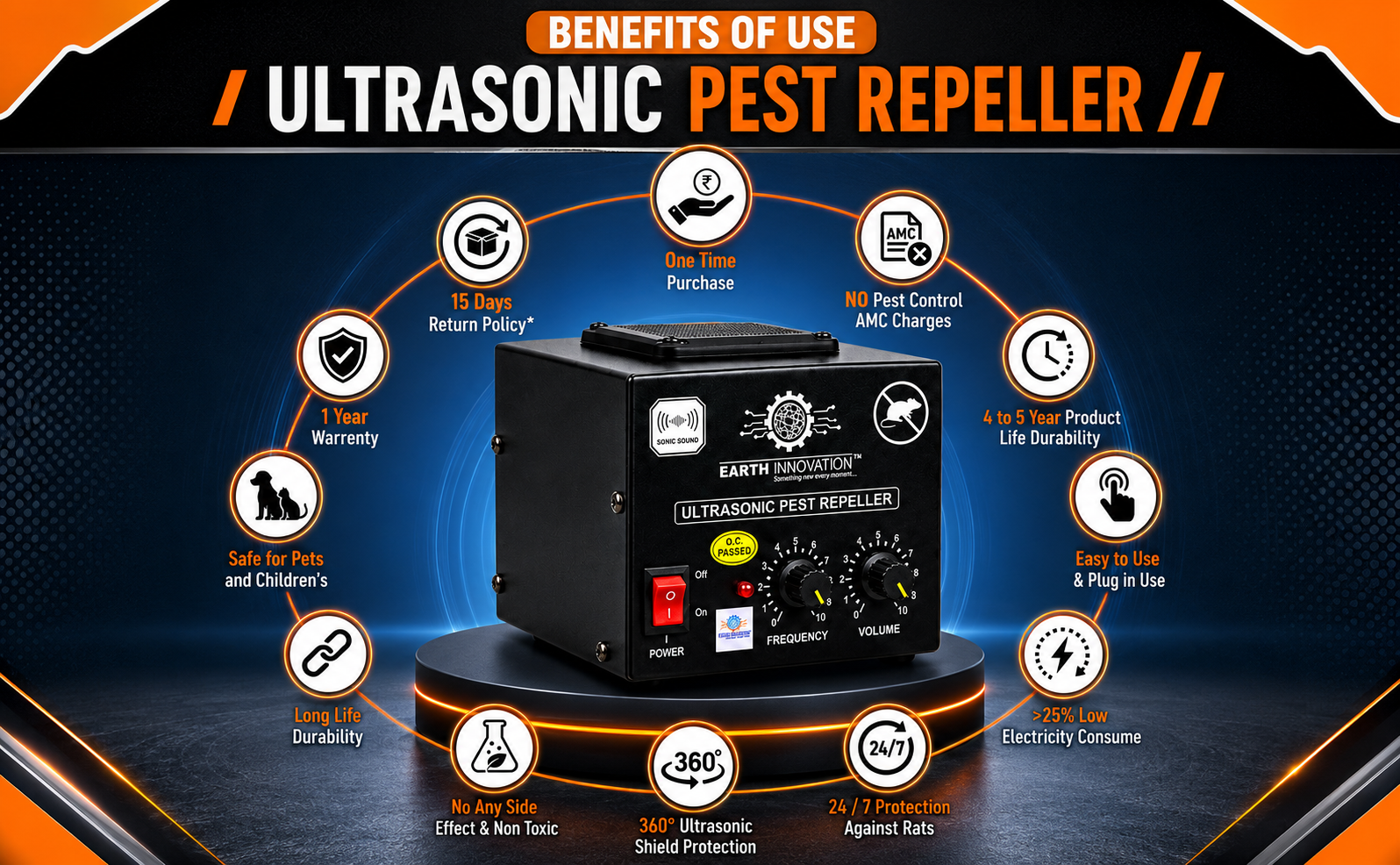
- Power draw — a well-designed plug-in unit should run on just a few watts, so leaving it on continuously costs very little
- Warranty and support — look for at least a 1-year warranty and a clear returns policy, since this is the easiest way to tell a manufacturer that stands behind its product from one that doesn’t
For vehicles specifically, use a device actually designed for a car’s environment rather than a household plug-in unit — cars have become a genuine rodent hotspot in Indian cities, partly because modern wiring insulation is often soy-based, which rodents find far more appetizing to chew than older plastics.
Is It Safe Around Children and Pets?
Generally, yes, for people, children, dogs, and cats — these devices involve no chemicals, poison, or exposed toxic parts, and while dogs and cats can technically hear part of the ultrasonic range, available research doesn’t show established long-term harm. The one group worth real caution with: small pet rodents and rabbits (hamsters, gerbils, guinea pigs), since the device doesn’t distinguish a pet from a wild rat. Keep units away from their cages and avoid running one in the same room.
A Simple Action Plan
- Walk your home, shop, or warehouse and note every place you’ve seen droppings, gnaw marks, or heard scratching
- Seal the obvious entry points first — drains, AC pipe gaps, door bottoms
- Remove easily accessible food, water, and nesting clutter
- Install your ultrasonic device(s) with a clear sightline to the problem areas, sized to your actual coverage need
- Give it 1–3 weeks of continuous use before judging results, and monitor activity rather than assuming the first day’s silence means success
The Bottom Line
An ultrasonic rat repellent is a genuinely useful, chemical-free tool — but it works best as part of a plan, not as a replacement for one. Earth Innovation’s range covers everything from a single bedroom to a full industrial floor, all built on frequency-shifting technology designed specifically to avoid the habituation problem that gives basic ultrasonic devices a bad name.
Have a more specific question? Our complete FAQ covers 95 questions on safety, placement, coverage, and more.